In this Insights post, eLaHub explores what we can learn from the different experiences and needs of neurodivergent people, and how these insights can help us design more accessible and inclusive learning.
In the latest edition of the eLaHub Accessibility Briefing, I share some personal reflections on my experience of neurodivergence and what I’ve learnt about inclusive learning design.
The newsletter was inspired by my recent session on neuroinclusive learning design at World of Learning, where I revisited an exercise I’d first developed with Emma Hutchins from Aviva for our conference presentation last year.
When Emma and I began planning our original session, we discovered that although we were both neurodivergent, our experiences, strengths and challenges were quite different. We had different neurodivergent conditions, different experiences of diagnosis and different combinations of strengths and challenges.
We decided to create individual neurodivergent profiles to explore those differences, including the things we found difficult and the strengths we’d come to recognise in ourselves.
My neurodivergent profile
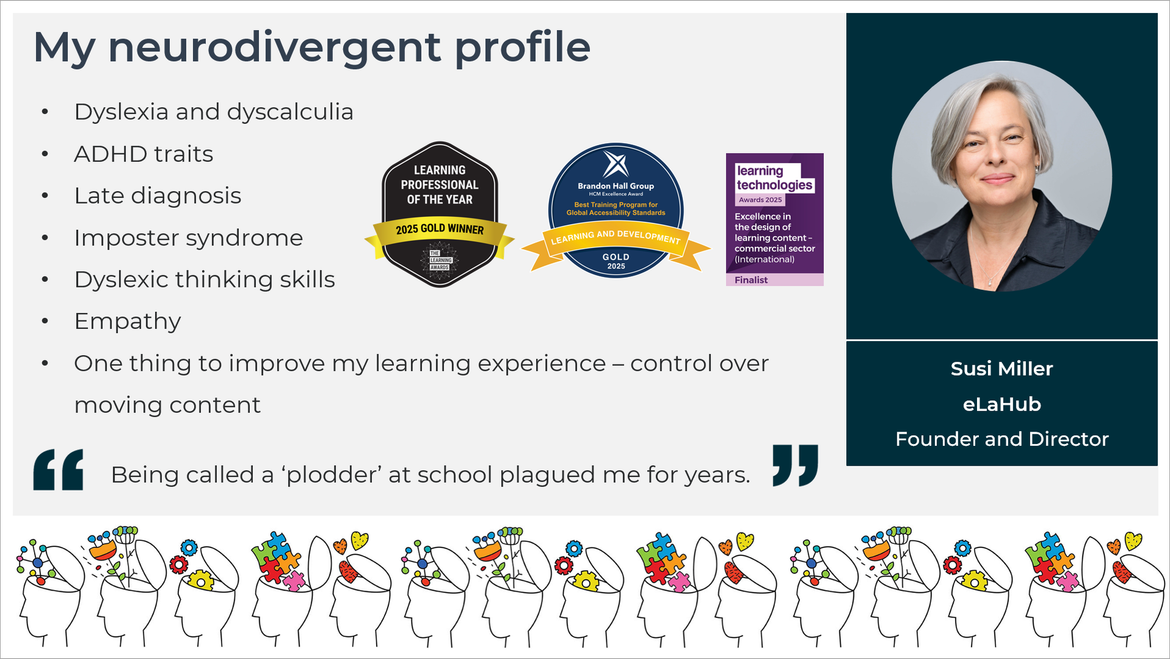
Creating my profile turned out to be a surprisingly personal experience. It made me reflect on my late diagnosis of dyslexia and dyscalculia, the impact of experiences I’d carried with me since childhood and how discovering dyslexic thinking skills had changed the way I understood my abilities.
But it also raised an important question about learning design.
If two neurodivergent people can have such different experiences and needs, how can we design learning that’s inclusive for both of them, let alone everyone else?
What’s the one thing?
As part of creating our profiles, Emma and I each identified one thing that could be improved to make learning more accessible and usable for us. For me, it was having control over moving content. Even a small decorative animation that I can’t stop can make it almost impossible for me to concentrate on the information I’m trying to process. For Emma, it was reducing verbal instructions.
We wanted to find out what other neurodivergent people thought, so we invited contributions through LinkedIn and Aviva’s 450-strong Neurodivergent Community.
We asked:
What’s the one thing that could be improved to make learning more accessible and usable for you?
The responses were incredibly varied, reflecting just how differently neurodivergent people can experience learning. But when we explored them more closely, some common themes began to emerge, particularly around control, flexibility, clarity and predictability. These are also areas where we regularly encounter accessibility barriers in our auditing work at eLaHub. And they raise some important questions about the decisions we make when designing learning.
What does this mean for learning design?
We can’t possibly anticipate every individual’s needs, particularly when people with the same neurodivergent condition can have very different experiences. But what can we learn from those differences? Are there common principles that can help us create learning that’s more accessible and inclusive? And are there relatively simple changes we could make that would improve learning for more people?
In the latest eLaHub Accessibility Briefing, I explore what we discovered from people’s responses and what it means for learning design.
I also share something much more personal: how creating my own neurodivergent profile helped me reflect on experiences that have shaped my confidence, my career and the way I think about my abilities.
And we’d still love to know your answer to the question:
What’s the one thing that would make learning more accessible and usable for you?
About this article
Written by: Susi Miller and the eLaHub team
Published: October 2026
Useful links
- No two neurodivergent profiles are the same. So where does that leave learning design? – eLaHub Accessibility Briefing
- Made By Dyslexia – Dyslexic Thinking
- WCAG 2.2 Quick Reference – How to Meet WCAG
- eLearning Accessibility Auditing Services – eLaHub